
RGB Led
Multiplexed RGB LED module with analog 4-channel mux and current-limited red, green, and blue channels for the PomeLabs Core Kit.
The PomeLabs RGB LED Module (PML-RGB-01) turns three independent light channels — red, green, and blue — into a single controllable color output. A 4-channel analog multiplexer routes Backend MCU signals to each LED channel through precision current-limiting resistors, giving you software-controlled color mixing, brightness modulation, and visual state indication in one compact module.
Revision: v1.0 | Part Number: PML-RGB-01 | Series: PomeLabs Core Kit
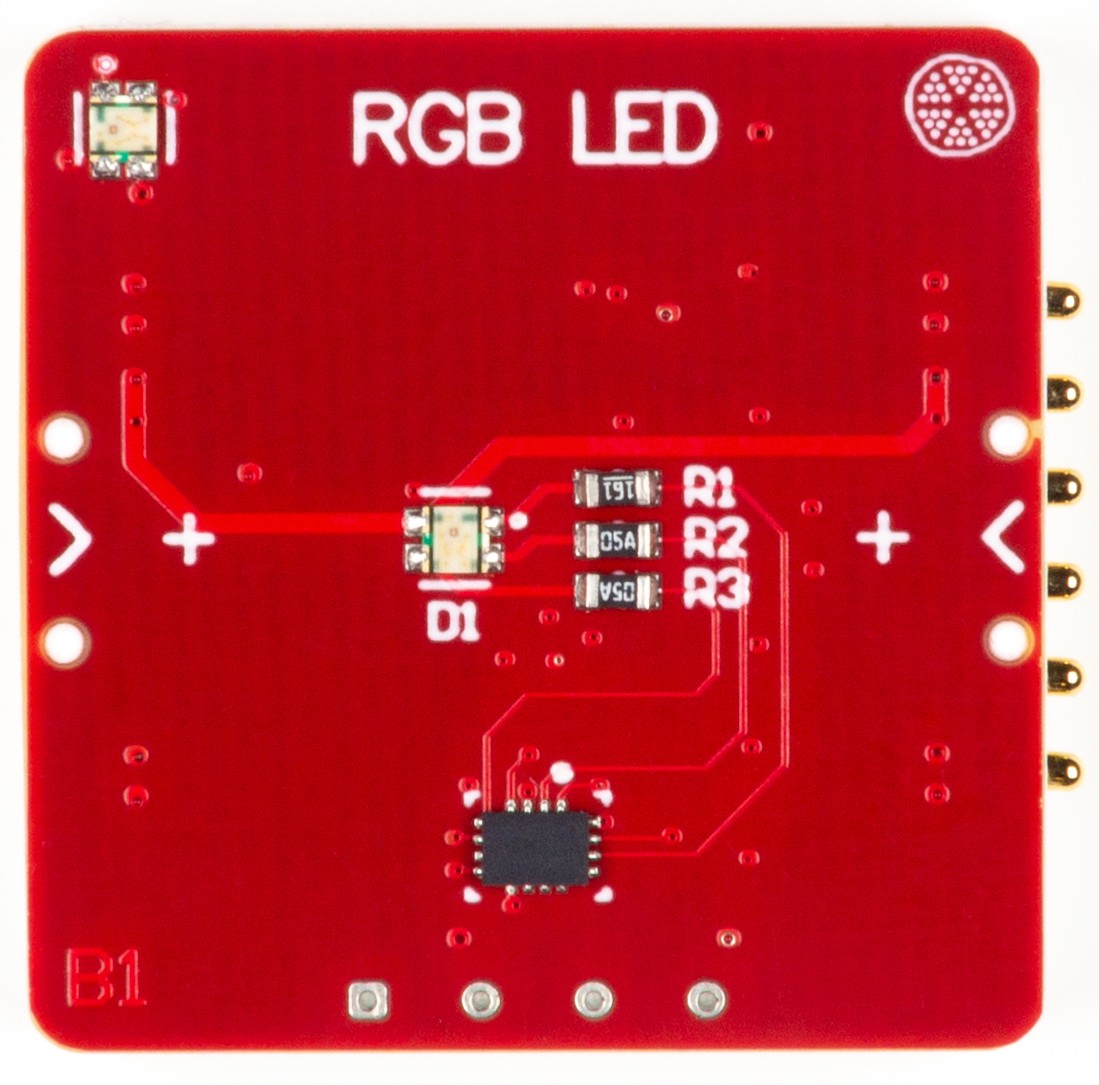
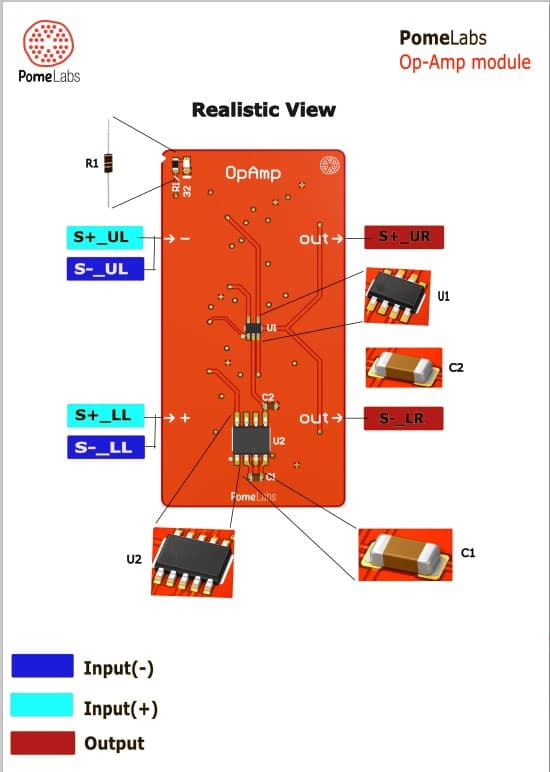
Pinout
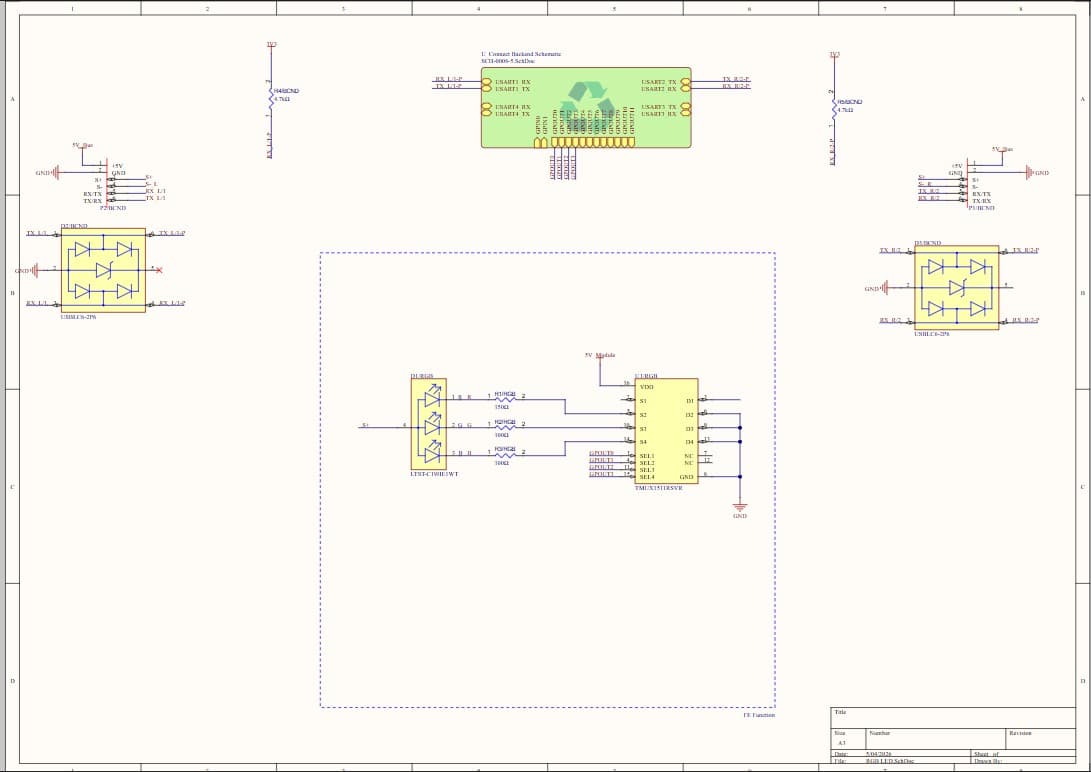
Schematic
Digital Twin
In the PomeLabs App, the PML-RGB-01 is mirrored as a digital twin in both the Playground and inside any Connect Activity. Control each color channel independently from the App — set PWM duty cycles, step through color combinations, or trigger color changes from logic outputs in real time.
Controls — parameters you can set from the App
Red channel select · pin GPOUT0 → SEL1 · toggle / PWM
Controls the SEL1 input of U2 (TMUX1511ESVR) to route signal to the Red LED channel through R1 ( current limiter).
Green channel select · pin GPOUT1 → SEL2 · toggle / PWM
Controls SEL2 to route signal to the Green LED channel through R2 ( current limiter).
Blue channel select · pin GPOUT2 → SEL3 · toggle / PWM
Controls SEL3 to route signal to the Blue LED channel through R3 ( current limiter).
Channel 4 select · pin GPOUT3 → SEL4 · toggle / PWM
Controls SEL4 — fourth mux channel, available for auxiliary use or future expansion.
UART TX — Left / Right ports · serial data sources
Drives USART1/USART2 transmit lines through D1/D2 ESD protection.
Monitors — values streamed back from the module
LED state · U1 (LFST-C19H3WT) · color indicator
Live color state of the RGB LED based on active channel selection. Reflects current R/G/B combination.
UART RX — Left / Right ports · serial data traces
Inbound data from downstream nodes through D1/D2 ESD protection back to the Backend MCU.
Datasheet
1. Overview
The PML-RGB-01 centers on two ICs inside the FE Function block: the LFST-C19H3WT (U1) — a through-hole RGB LED with red, green, and blue emitters in a single package — and the TMUX1511ESVR (U2) — a 4-channel analog multiplexer that routes Backend MCU GPIO signals to the individual LED channels under select-line control.
The architecture separates signal routing from current limiting. U2 handles channel selection via four GPIO-driven select lines (SEL1–SEL4 from GPOUT0–GPOUT3). The current through each LED channel is set by dedicated series resistors: R1 () on the Red channel and R2, R3 ( each) on the Green and Blue channels. The resistor values are chosen to balance perceived brightness across the three emitters given their different forward voltages and luminous efficacy.
Two USBLC6-2P6 ESD protection devices (D1, D2) protect both UART communication ports.
2. BOM Components
| Ref. | Type | Value / Part | Role on this module |
|---|---|---|---|
| U1 | RGB LED | LFST-C19H3WT | Single-package RGB LED with separate red, green, and blue emitters. Each emitter driven independently through its own current-limiting resistor. |
| U2 | 4-channel analog multiplexer | TMUX1511ESVR (TI) | Routes Backend MCU GPIO signals to LED channels via select lines SEL1–SEL4. Inputs S1–S4 from MCU; outputs D1–D4 to LED channels. Low on-resistance, wide supply range. |
| R1 | Current-limiting resistor | Series resistor on Red LED channel. Lower value compensates for Red emitter's lower forward voltage — balances perceived brightness. | |
| R2 | Current-limiting resistor | Series resistor on Green LED channel. Limits Green emitter drive current. | |
| R3 | Current-limiting resistor | Series resistor on Blue LED channel. Limits Blue emitter drive current. Identical to R2. | |
| D1 | ESD protection IC | USBLC6-2P6 (ST) | IEC Level ESD clamp on Left UART port. max. SOT-666. |
| D2 | ESD protection IC | USBLC6-2P6 (ST) | IEC Level ESD clamp on Right UART port. Identical to D1. |
| R4 | Resistor | Pull-up resistor on UART lines to . | |
| p1, p2 | Connector | Node headers | Left and Right node connectors exposing , GND, S+, S−, RX/TX, TX/RX. |
3. Electrical Specifications
3.1 U1 — LFST-C19H3WT (RGB LED)
3.1.1 Absolute Maximum Ratings
Exceeding these values may permanently damage the LED. Stress ratings only.
| Parameter | Red | Green | Blue | Unit |
|---|---|---|---|---|
| Forward current () continuous | mA | |||
| Peak forward current (, pulse, duty) | mA | |||
| Reverse voltage () | V | |||
| Power dissipation () | mW | |||
| Operating temperature | to | to | to | °C |
| Storage temperature | to | to | to | °C |
3.1.2 Recommended Operating Condition
Conditions for reliable operation and optimal performance.
| Parameter | Red | Green | Blue | Unit |
|---|---|---|---|---|
| Forward current () | mA | |||
| Peak forward current (, pulse, duty) | mA | |||
| Operating temperature | to | to | to | °C |
| Forward voltage (, at ) | – | – | – | V |
| Reverse current (, at ) | A | |||
| Luminous intensity (, at ) | – | – | – | mcd |
| Dominant wavelength () | – | – | – | nm |
| Viewing angle () | deg |
3.2 U2 — TMUX1511ESVR (4-Channel Analog Mux)
3.2.1 Absolute Maximum Ratings
Exceeding these values may permanently damage the device. Stress ratings only.
| Parameter | Max Value | Unit |
|---|---|---|
| Supply voltage () | V | |
| Signal voltage on any I/O pin | to | V |
| Select pin voltage | to | V |
| Continuous current per channel | mA | |
| Operating junction temperature () | to | °C |
| Storage temperature () | to | °C |
3.2.2 Recommended Operating Conditions
| Parameter | Min | Typ | Max | Unit |
|---|---|---|---|---|
| Supply voltage () | – | V | ||
| Signal path I/O voltage (source/drain pins) | – | V | ||
| Control input voltage (SELx pins) | – | V | ||
| Ambient temperature () | – | °C | ||
| On-resistance () | – | |||
| On-capacitance () | – | pF | ||
| Off-capacitance () | – | – | pF | |
| Bandwidth | – | – | MHz | |
| (logic input high voltage) | – | – | V | |
| (logic input low voltage) | – | – | V | |
| Input/Output leakage current (ON-state) | – | – | A |
Note: When , the signal path I/O voltage range is limited to –. The device supports input voltages beyond the supply rail, up to (maximum ) when powered within the recommended range.
4. Channel Select Truth Table
SEL1–SEL4 driven by GPOUT0–GPOUT3 from the Backend MCU. Multiple channels can be active simultaneously for color mixing.
| SEL1 (GPOUT0) | SEL2 (GPOUT1) | SEL3 (GPOUT2) | Active Channel | LED Color |
|---|---|---|---|---|
| H | L | L | S1 → D1 → R1 → Red | Red |
| L | H | L | S2 → D2 → R2 → Green | Green |
| L | L | H | S3 → D3 → R3 → Blue | Blue |
| H | H | L | S1 + S2 → Red + Green | Yellow |
| H | L | H | S1 + S3 → Red + Blue | Magenta |
| L | H | H | S2 + S3 → Green + Blue | Cyan |
| H | H | H | S1 + S2 + S3 → All | White |
| L | L | L | None | Off |
6. Pin Descriptions
All signal pins referenced to GND.
| Pin / Net Name | Direction | Description |
|---|---|---|
| GPOUT0 → SEL1 | Input | Select line 1 from Backend MCU. HIGH enables Red channel route through U2 S1→D1→R1→Red LED. |
| GPOUT1 → SEL2 | Input | Select line 2 from Backend MCU. HIGH enables Green channel route through U2 S2→D2→R2→Green LED. |
| GPOUT2 → SEL3 | Input | Select line 3 from Backend MCU. HIGH enables Blue channel route through U2 S3→D3→R3→Blue LED. |
| GPOUT3 → SEL4 | Input | Select line 4 from Backend MCU. Fourth mux channel for auxiliary use. |
| 5V_Module → VDD3 | Power In | supply to U2 VDD and LED anode rail. |
| GND | Ground | Common ground for U2, LED cathodes, and all connectors. |
| TX_L-1 / RX_L-1 | Input / Output | UART Left port through D1 ESD protection. |
| TX_R-2 / RX_R-2 | Input / Output | UART Right port through D2 ESD protection. |
7. Connection Guide & Common Errors
Correct power-up sequence:
- Connect GND first, shared across all modules.
- Connect 5V_Module to a regulated source — this powers both U2 VDD and the LED anode rail.
- Ensure all SEL lines (GPOUT0–GPOUT3) are LOW before power-up to prevent uncontrolled LED activation.
- Drive SEL lines from Backend MCU GPIO outputs. Use PWM for brightness control.
Common wiring errors and consequences:
| Mistake | Symptom | Correction |
|---|---|---|
| SEL lines driven HIGH continuously at full duty cycle | LED overdriven — reduced lifetime, potential permanent damage | Use PWM to control brightness. Recommended duty cycle for continuous operation. |
| 5V_Module supply exceeds | U2 (TMUX1511ESVR) permanently damaged | Keep supply . |
| SEL lines left floating | Random LED activation — undefined mux state | Always drive SEL lines from a defined logic source. Pull to GND if unused. |
| GND not shared with Backend MCU | SEL logic thresholds shift — unreliable channel switching | Ensure a single common GND bus across all modules. |
| USBLC6-2P6 VBUS unconnected on D1 or D2 | ESD protection ineffective | Connect VBUS of D1 and D2 to 5V_Module. |
Hands-on Labs
Get started with the PML-RGB-01 through guided labs that build from single-channel control to PWM color mixing and state-machine-driven color sequences. Each lab opens in the PomeLabs app.
RGB LED Onboarding
Power up the module, activate each color channel individually via GPIO, and step through the full color combination truth table. Recommended starting point.
PWM Brightness Control
Apply PWM signals to each SEL line and observe how duty cycle controls perceived brightness — explore the relationship between frequency, duty cycle, and human visual perception.
Color Mixing
Activate multiple channels simultaneously with different duty cycles to mix colors — reproduce specific hues and explore the additive color model in hardware.
State Machine Color Sequencer
Connect D Flip-Flop modules to the SEL lines to build a clocked color sequencer — step through color states automatically on each clock edge.
Use Cases
Coming soon.
How is this guide?